Things to Do in Stuttgart
The automobile was born here. The Spätzle might be the greater invention.
Top Things to Do in Stuttgart
Find activities and tours you'll actually want to do. Book through our partners -- no booking fees.


Plan Your Trip
Essential guides for timing and budgeting
Climate Guide
Best times to visit based on weather and events
View guide →Day Trips
The best excursions and nearby destinations worth the journey
Explore day trips →Where to Stay
Best neighbourhoods, hotel picks, and booking tips
Find hotels →Travel Insurance
What's required, what coverage matters, and how to get a quote
Read guide →What to Pack
Climate-specific gear, essentials, and what to leave at home
See packing list →When Should You Visit Stuttgart?
Tap a month for weather, crowds, and highlights
View full year-round climate guide →Road Trips from Stuttgart
Explore scenic driving routes and epic journeys
Explore Stuttgart
Bad Cannstatt
District
Konigstrae Shopping District
Landmark
Markthalle Stuttgart
Landmark
Mercedes Benz Museum
Landmark
New Palace Neues Schloss
Landmark
Old Castle Altes Schloss
Landmark
Porsche Museum
Landmark
Rosenstein Park
Landmark
Schlossplatz
Landmark
Solitude Palace
Landmark
Stuttgart Ballet
Landmark
Stuttgart City Center
District
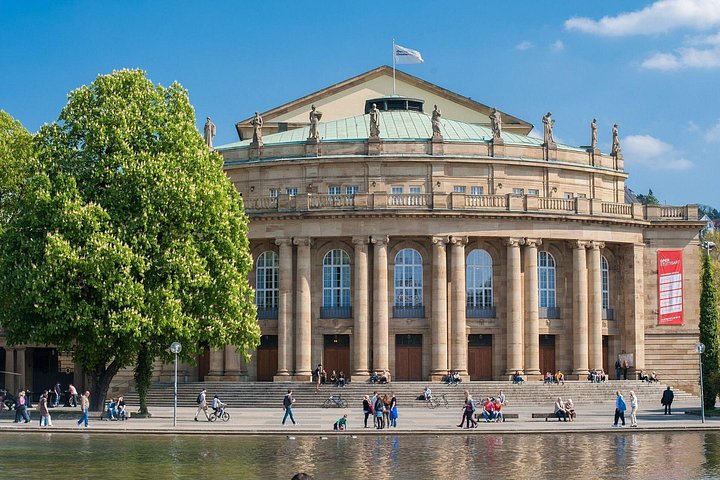
Stuttgart State Opera
Landmark
Stuttgart Tv Tower
Landmark
Stuttgart Wine Region
City
Weissenhof Estate
Landmark
Wilhelma Zoo And Botanical Garden
Landmark
Your Guide to Stuttgart
About Stuttgart
Stuttgart smells of motor oil and Riesling. That clash defines the city. It sits in a Kessel, a natural basin ringed by forested hills and working vineyards that climb right to the autobahn. From the Fernsehturm observation deck, the world's first reinforced-concrete television tower, you can spot the Porsche smokestacks in Zuffenhausen and, in the same sweep, the Trollinger vines that Swabians have tended since the Romans left.
Germany's car capital is also one of its largest wine-growing cities, and both sides are taken seriously. Schlossplatz anchors the center, a wide Baroque square where office workers sprawl between the Neues Schloss and the Königsbau arcade. The real texture hides in the margins. The Bohnenviertel, south of Marktplatz, is a former artisan quarter where wine bars fill half-timbered buildings that survived Allied bombing.
The Markthalle, an Art Nouveau hall on Dorotheenstraße, slaps you with the scent of fresh Maultaschen dough, Turkish pide, and roasted coffee before you reach the door. The Stäffele, over four hundred outdoor staircases carved into hillsides, link neighborhoods vertically and give the city a third dimension rare in Germany.
Stuttgart's weakness is its sky. The basin traps winter cloud cover and summer humidity. January can feel relentlessly gray. Yet the same geography that holds the fog also holds the warmth that ripens grapes. The best rewards demand a climb.
Travel Tips
Transportation: Stuttgart's VVS network knits together S-Bahn commuter trains, Stadtbahn light rail, and buses across the city and deep into the countryside. The StuttCard bundles unlimited transit with free museum entry and usually pays for itself within a single day of moving around. Download the VVS app before you land. It handles route planning and mobile tickets, since station machines can be fussy with foreign payment cards. Skip airport taxis and ride the S-Bahn instead, saving considerably for the same trip into the center. Do not ignore the Stäffele, those hillside staircases threading through vineyards. They are not just scenic walks but often the fastest route between neighborhoods that the road network connects with frustrating switchbacks.
Money: Germany runs on cash more than most visitors expect. Stuttgart is no different. Many restaurants, bakeries, and smaller shops still refuse credit cards, so carry euros. The EC-Karte, Germany's domestic debit system, is accepted far more widely than Visa or Mastercard. Your foreign debit card might work where your credit card will not. ATMs from Sparkasse and Volksbank usually charge no withdrawal fee for most international cards. Standalone machines in tourist zones often slip in a surcharge. Tipping follows the Swabian approach: modest, not performative. Round up at cafes. Leave a bit extra at sit-down restaurants. Hand it to your server directly rather than leaving it on the table.
Cultural Respect: Swabians are warm people who show it through precision, not effusion. The Kehrwoche, a rotating duty where residents scrub the shared stairwell on a strict weekly schedule, tells you how the city thinks. Order is care. Sunday is shut. Shops close. Supermarkets lock. Quiet is enforced by law and by neighbors who will let you know if your music drifts. The Swabian dialect is thick enough to puzzle native German speakers from Hamburg. Do not feel bad if you catch half of what the Besenwirtschaft owner says. Most people under forty speak solid English. They still appreciate a clumsy Guten Tag.
Food Safety: Swabian cooking is peasant food turned regional religion. Maultaschen, pasta pockets stuffed with meat, spinach, and onion, were allegedly invented by monks hiding meat from God during Lent. You will find them in broth, sliced and pan-fried with eggs, or baked under cheese. Spätzle, the hand-scraped egg noodles, are civic pride here. They arrive under roasted onions as Zwiebelrostbraten or drowned in melted Emmentaler as Käsespätzle. German hygiene standards are strict. Stomach trouble is rare. Tap water is safe everywhere in Stuttgart. Time your visit for a Besenwirtschaft, the seasonal taverns where local winemakers pour new-vintage Trollinger alongside cold cuts in their own homes. It feels like eating in someone's living room. You are.
When to Visit
Stuttgart swings through every season hard. The Kessel basin cranks the dial: summers roast, winters fog, and spring jumps the gun by fourteen days inside the bowl.
April to June wins. Thermometers rise from 15°C (59°F) in early April to 23°C (73°F) by June. Vineyards flash green overnight. Locals reclaim Cannstatter Wasen for Frühlingsfest, a three-week spring party starting mid-April. Tourists are rare. Beer lines stay short. Hotels still have rooms. Mercedes-Benz Museum and Porsche Museum feel almost private.
July and August cook. Highs hit the upper twenties, sometimes 30°C (86°F). The basin traps heat. Escape to Schlossplatz open-air cinema. Soak in Bad Cannnstadt mineral baths. Romans loved these springs. Bohnenviertel wine bars glow past nine. Humidity bites by noon. Summer rates spike. Weekend rooms vanish.
September and October serve Stuttgart at its tastiest. Weindorf pops up late August through early September. Schillerplatz and Marktplatz host thirty wine stands. Cannstatter Volksfest lands late September for three weeks. Second only to Oktoberfest. Same rides, same roar, fewer passports. Mid-teens Celsius. Upper fifties Fahrenheit. Good for the Stäffele steps. No sweat. Hotel prices slide. Vineyard leaves catch fire.
November through February is monochrome. Gray settles in. Clouds sit low. Thermometers flirt with 0°C (32°F). Daylight gone by four. Exception: Weihnachtsmarkt. Late November through late December. Two hundred stalls. Glühwein steams. Roasted almonds crackle. Carved wooden ornaments. Swabian hands still shape them. Rooms hit rock bottom outside Christmas weeks. Brave the cold. You will own the museums, the Stäffele, the Besenwirtschaften.
More Ways to Experience Stuttgart
Tours, day trips, and local experiences curated by on-the-ground operators.
Didn't see anything interesting yet?
Browse Viator's full catalog of tours, day trips, food experiences, and private guides in Stuttgart.
See All Stuttgart Tours on Viator